My Blogs

Personal Coaching and Training Information
for Cyclists of All Abilities
Training Resources
and Products
My Blog Archive
Get the benefits of bike commuting without riding your bike to work!
Communting to work by bike is an excellent way to get base miles into your legs, if you can manage it. However, most of us can come up with lots of reasons why we can't commute, some of which are true and others are just an excuse. There's the darkness, the cold, snow and ice, traffic, the distance, inconvenience of showering and changing at work, carrying your briefcase and clothing, blah, blah blah. But even if you can't commute by bike for whatever reason, I discovered yesterday that you can still get the benefits of commuting twice a day, but not by riding your bike to and from work.
Yesterday I wanted to get in an hour of riding, but ran out of time in the morning so I just did a half hour on my trainer. Later in the evening I finished up the other half hour. Reminded me of football players who do twice-a-day workouts. It then dawned on me this is what bike commuters do also - they get in two rides a day. They may not be very long, if you don't live far from work, but you at least get your body working twice a day and the effects of training are cummulative to a great degree. So, here's a suggestion. Hop on your trainer in the morning when you get up. (Yes, you will still have to get up a little earlier than normal just like real bike commuters do) Ride however far you wish to go, get cleaned up and drive to work. When you return from work, hop on again and complete your daily workout. This offers the extra benefit of being able to decide when to do your evening ride. You don't necessarily have to do it right after work (although I'd suggest you do otherwise if you put it off, you might 'forget' to do it later!) Voila! Bike commuting at home.
What is Reverse Periodization and should you be doing it?
You most likely have heard the term 'Periodization' thrown around if you'd done much reading at all about training, for cycling or any other sport. Periodization refers to a systematic approach to training, usually starting with easier workouts of longer duration and building to shorter, more intense workouts. In cycling, almost every book starts out with a Base or Foundation period, where you build conditioning through long, fairly easy rides, often called LSD rides, for Long Slow Distance, or Long Steady Distance. Then during the spring you will add more intense threshold type intervals and in the weeks prior to your big event, you add in veryintense anaerobic intervals. There's nothing wrong with this approach and it has been used for years very successfully by many great cyclists and coaches.
The one problem I have with this approach is this classic periodization assumes you do your longest rides duing the winter and early spring. That just doesn't work in places where winter happens. Yes, we can bundle up and go out and ride for an hour or two before we lose feeling in our fingers and toes, but often the roads are not safe to ride or the wind chill is just too dangerous. Also, if you have a job, chances are you go to work and come home in the dark, so options for riding outside is very limited. Yes, there are indoor trainers but again it takes someone of massive motivation to do many hours a week building base miles on a trainer, and regardless of the type of trainer you have, it's just not the same as riding outside. So what are our options in the winter if we can't get lots of base miles in?
One option is to do another aerobic sport such as cross country skiing or snowshoeing, if possible. If the conditions are right, you can do this when it's very cold for 2 or more hours at a time. If this doesn't work and you can't imagine sitting on your trainer for hours at a time, the other option is to do shorter trainer workouts but make them more intense so you still get a good cardio workout. Reverse Periodization is where you do more intense training prior to your long base miles. In this case, I'm referring to doing shorter sessions containing more intense work in the winter and early spring in place of long steady distance miles. I don't personally have a problem doing some moderate and even some anaerobic workouts year-round, especially if you can't follow the traditional periodization model. But here's another reason. Any more, you cannot afford to get too out of shape in the off-season if you compete, and as you get older this is especially true. Keeping some intensity in your program is going to be beneficial. Just do most of it in the threshold (zone 4) area and a little bit in zone 5 or 6 (anaerobic). Also, don't do so much that you are mentally fried when spring comes. Just once or twice a week throw in a harder workout and try to get in longer workouts on the weekends. Besides, I find doing long indoor training sessions harder on my motivation than doing harder but shorter workouts. Then as the weather improves, switch to doing more longer rides to build endurance for the upcoming season. But keep doing at least one interval workout each week. I don't believe this will harm you and may actually benefit you more than trying to grind out long rides either in freezing weather or indoors.
Do you feel stronger after being sick?
I sometimes hear the comment that people feel stronger on the bike after taking a few days off when they have been sick or for some other reason. Logic would tell us the first workout back on the bike might not be very pretty after being off the bike for a few days, especially if we have been sick. We can envision our fitness just fleeing our body hourly when we aren't training everyday. Then people are often pleasantly surprised when they get on the bike to find out they feel stronger than they thought they would and perhaps even stronger than they were before they got sick. How can this be? Well, it's because when we are forced off the bike for three days or so, our bodies get a chance to fully recover, something we rarely let it do when training 3 or more times per week. Even if you take a day off between your riding, you don't fully recover. You recover enough to train hard again the next day, but you aren't fully recovered. When you take a few days off though, your body and legs get a chance at full recovery and come back feeling fresh and ready to work hard. Yes, you have probably lost just a bit of fitness but not as much as you think you have. And your renewed freshness should allow you to train harder when you restart so you will quickly get your fitness back and then some. So don't fret if you get sick and don't ride for a few days, or if you have a business trip for a few days. View it as a chance to get a full recovery and look forward when you can get back on your bike to use your new-found freshness. More than 3 or 4 days though and you will start to lose noticable fitness.
Should You Train When You Are Sick?
I picked up a cold this week and it reminded me of the question I get often - "Should I train when I am sick?" The simple rule of thumb I've heard is that if your illness is limited above your neck, it's okay to train. If its below the neck, rest and don't train. This is a good starting point but you should also apply some common sense and base it on how you feel. My cold is in my chest and throat, so according to this rule, I shouldn't train. But I felt restless (I didn't train yesterday) and I wanted to move a little and felt like it. So I rode 10 easy miles on my rollers (below zero wind chill outside today) and felt okay doing it. However, there have been times when I've had a head cold and according to this rule, I should have trained, but when you have a headache and stuffed sinuses, it's hard to force yourself to train and even if you do, you probably won't get a decent workout. This is where the common sense comes in. Listen to your body. Think about whether training may make your condition worse and delay recovery, or might it help? Base it on how you feel, too. If you feel like training, chances are good that you may benefit. Just tone back the intensity and focus on moving your body and getting your heart rate up. Save the hard riding for when you feel better.
10 Reasons to Ride Your Mountain Bike This Winter
Here are 10 reasons why you should ride your mountain bikes this winter.
Simple vs Complex Carbs - if it were only that simple
We all hear talk about simple vs complex carbs, usually how the simple ones are bad for us and the complex ones are good for us. If it were only that simple, but it's more complex than that! Simple sugars are those with either just one (e.g. glucose) or two (e.g. sucrose) monosaccharide molecules. Complex carbohydrates are defined as any carb that has three or more monosaccharide molecules. Complex carbs are typically starches of various sorts, but can also be shorter glucose chains such as maltodextrins. You will typically hear people say how we should eating complex carbs because they are better for us than sugars. What they are implying is that complex carbs (starches) will digest more slowly and therefore create a slower, more steady rise in blood sugar. This is only partially true. While some starchy foods are more slowly digested, that's not always the case. Not all complex carbs are slow digesting. In fact, some 'complex carbs' raise blood sugar more quickly than some 'simple' sugars. Just because a carb is complex shouldn't lead you to automatically believe it is slow digesting.
Read the rest of the article.
Some tips for using chemical toe warmers
As the weather turns colder, it is possible to continue riding outside by adding more and more layers of clothing. However, my feet are usually the first thing to get cold which limits the length of rides I can get in. Therefore, I use chemical toe warmers which are now available at sporting goods stores (I guess hunters use them too). Here are a couple of tips for using them, because they can quickly become deactivated by moisture.
One method I have used is to put my socks on, them put my toes in a plastic sandwich bag (I've heard Subway sandwich bags work well too), then put the toe warmer in the sole of the shoe. Toe warmers have a sticky side so it stays put once you put it in the shoe. By wearing a plastic baggie, you keep your feet off the toe warmer. Even on the coldest days, your feet will sweat and the moisture will eventually deactive the toe warmers.
Another method I've gone to recently is to put on my socks and shoes as normal, but then stick the toe warmers on the outside of the shoe on the toe. Then I put on my shoe covers. If it is cold enough for toe warmers (I use them when its 35 degrees F or colder), then its cold enough for shoe covers too. This method keeps some distance and your shoe between your sweating feet and the toe warmers, although eventually even these will deactive on longer rides.
Give it a try and play around with it until you find a system that works for you. I typically find these last at least an hour and a half using the above methods.
Will Donating Blood Negatively Affect My Cycling Performance?
The local Blood Center called the other day and asked me to give blood again. So I gave blood. I have donated blood since I was in college and have given at least once each year since then. I like giving blood. I have lost track how much I've given, but it's over the 3 gallon mark. It's a chance to do something for others that requires giving of myself (literally!). You can't just write a check and have blood instantly appear. You have to donate your blood to help one or more people who are in need of it. Because giving blood means giving away my hard-earned red blood cells, is this something I should be doing as a competitive cyclist? Won't it negatively affect my cycling performance? After all, isn't gaining more blood cells what aerobic and anaerobic training is largely about, why people train at altitude, and why some unethical cyclists use erythropoietin (EPO)? Yes, yes, and yes. So why would I want to give away my precious red blood cells, and why this time of year? Read why here.
David's Awesome Oatmeal
Here's a great pre-ride meal full of great nutrients, slow burn energy and tastes great too! It's one of my favorites:
Fill a bowl half full with old fashioned rolled oats (not the quick oats - totally different effect)
Add a couple of spoonfuls of ground flaxseed, wheat germ and sunflower seeds.
Toss in a handful of raisins.
Add water (or skim milk) to cover and microwave for 2 minutes. Stir and add more water if necessary and microwave for one more minute, or until well heated.
If you wish add some protein powder and blueberries.
Top with a little brown sugar or maple syrup and a little milk if you desire.
It's ready to eat.
This contains lots of low glycemic carbs which will be released into your bloodstream throughout your ride providing a constant supply of glucose to keep you going. It also contains protein, fiber and omega-3s. Good stuff. Eat this about two hours before a long ride.
Enjoy!
Perfection is elusive and fleeting when you get it, but still worth pursuing
I did pretty well at training this past week. As I do with all of my coaching clients, I create a training plan for myself. I rarely complete the plan as designed but use it to guide me through the week. Sometimes I don't do all the workouts or cut them shorter than planned, either due to fatigue or other obligations. However, having a plan is invaluable as I wouldn't train nearly as much or as hard without it. But last week I did quite well, almost followed it perfectly and feel good about it. Which got me thinking about seeking and achieving perfection...
Perfection is difficult to achieve but that doesn't mean you shouldn't try. Now I'm not saying to become a 'perfectionist', which has implications of being so self-absorbed in achieving perfection, often in the minute details, that you lose sight of everything else. What I am suggesting is that you strive for excellence and perfection in those areas of your life that are worth pursuing, such as your career, family and of course cycling! If you are going to put the effort into training, you might as well put your best effort forward. You won't often achieve perfection but by aiming for it, you will achieve much more than if you settled for mediocrity, which is much easier to achieve, by the way.
Those times when you do achieve perfection are rare. Every so often you have a great training ride, where you felt strong and accomplished your goal for that ride, perhaps even blew it out of the water. Or, there are those rare races where you feel super strong and nothing can hold you back. Lance Armstrong refers to this feeling as 'no chain', meaning it feels like pedaling with no chain on your bike. And even when you achieve perfection, no matter how infrequently, it is fleeting. As they say in cycling, you are only as good as your last race. But this isn't a bad thing. Because we tend to fall short of perfection most of the time, this means that tomorrow we get another run (or in our case, bike) at it, to do a little better than today, to try a little harder. While perfection is fleeting, so is failing to reach perfection.
You see, perfection isn't a destination. Perfection is a lifelong pursuit. So give your best effort to those things that are important to you, day after day. If you fall down, pick yourself up and try again, a little harder. Even though you will rarely achieve perfection, your results will be greater for trying. This is true in cycling as well as life.
How to stay warm when it is freezing, literally
I got out on the road for a ride today for the first time this year. It was freezing, literally, as it was 31 degrees (F) when I started, but it was one of the warmest days of the year so far. I finished feeling comfortable so here's what I wore to stay warm, even though it was windy and I rode for more than 2 hours.
Feet: I wear wool socks (Smart Wool and Teko) and then wear winter bike shoes. I only use one pair of socks but some people use two. I have Sidi winter shoes but there are other brands such as Northwave. On longer rides, lasting more than 1.5 hours, I put charcoal toe warmers on the outside of my shoes, and then cover with heavy duty shoe covers. Get the heaviest ones you can find. I have Peal Izumi.
Legs: I have heavy duty bib leg warmers. These have a covered front which covers my chest which adds another layer of wind protection for my front.
Upper body: I start with a wicking undershirt and then put on a heavy turtleneck shirt. Then put on the bib leg warmers. Over that I wear my wool blend cycling jacket.
Hands: I wear heavy cycling gloves. There are several levels of heaviness you can find. I have three pairs and choose the pair depending on the temperature. For really cold days you might choose to wear ski gloves or mittens.
Head: On cold days, below 35F, I wear my winter cycling cap under my helmet. It's a Peal Izumi and had a visor and ear flaps. Not the most stylish piece of clothing but keeps my noggin warm. When its warmer, I just use a heavy ear/headband.
This is enough to keep me warm for at least 2 hours when its freezing out, literally. When you water bottle freezes, you know its cold.
How much leg strength training do you need?
During the off-season I like to recommend strength training for the legs. There are several good reasons for this, and I'll list them here. But the question then comes up, how much time and effort should you spend in the gym versus on your bike, either on the road or trainer, working on cardio fitness?
First, here are three good reasons to consider leg strength training:
1. It will make your legs stronger, which is especially useful if you are new to the sport or just aren't naturally very strong
2. It gives you sometime to do when the weather is lousy for ourdoor training and you can't stand another hour on the trainer.
3.
It helps with bone density, something cyclists should be concerned about.
So how much should you do? That depends on a number of things, but perhaps the most important is how much strength you need. Here are some things to consider when thinking about whether you should be spending your time on strength training or aerobic training. Keep in mind, the more strength training you do will interfere with your aerobic training..
If this describes you, consider doing 2-3 leg strength training sessions per week in the off-season::
- You want to do well in sprinting, attacking or climbing short, steep hills
- You don't time trial very well
- You have a hard time accelerating from a stop
- You are weak or do not have much in the way of leg muscle mass
- You tend to push a bigger (harder) gear and spin at a lower cadence
- You cannot put out a lot of power
If this describes you, consider just doing one leg strength training per week, and instead consider
doing more aerobic conditioning on the bike:
- You are a strong sprinter and can accelerate fast
- You have trouble keeping up with others on flat roads
- You are heavily muscled
- You have trouble keeping up with others on hills while seated in the saddle
- You can put out a lot of power but only for short periods of time.
- You do better on short steep hills than on longer less steep ones
These are completely hard and fast rules but may give you an idea of the considerations when planning your strength training program.
The Value of Tempo Riding
Like all coaches, I use a series of training zones to prescribe the amount of effort or intensity for my workouts. I happen to use six zone. Some coaches use five and some use seven. I find six to suit me and covers all the different intensities quite well. My six zones are:
1: Recovery
2. Endurance
3. Tempo
4. Threshold
5. Anaerobic
6. Maximum effort
This article focuses in on Zone 3, the Tempo Zone. This is perhaps the most mysterious and misunderstood zone there is. Tempo pace falls between Endurance and Threshold pace. Endurance pace is the speed your ride when out on long 2+ hour rides. It is a self-selected pace that is fairly comfortable and is well within the aerobic range. Threshold pace is the speed at which you are hovering right at the aerobic/anerobic threshold, where you breathing is hard. This is a pace you can maintain with effort for up to an hour. Tempo pace falls nicely between the two. I describe this intensity as neither hard nor easy, but requires concentration to keep it up. It may be about 2 mph faster than your endurance pace. You should be able to maintain this pace, with concentration for one to two hours without too much difficulty. For reference, I define Zone 3 as 82-91% of your anaerobic threshold heart rate, or 76-85% of your maximum heart rate. Read the rest of this article.
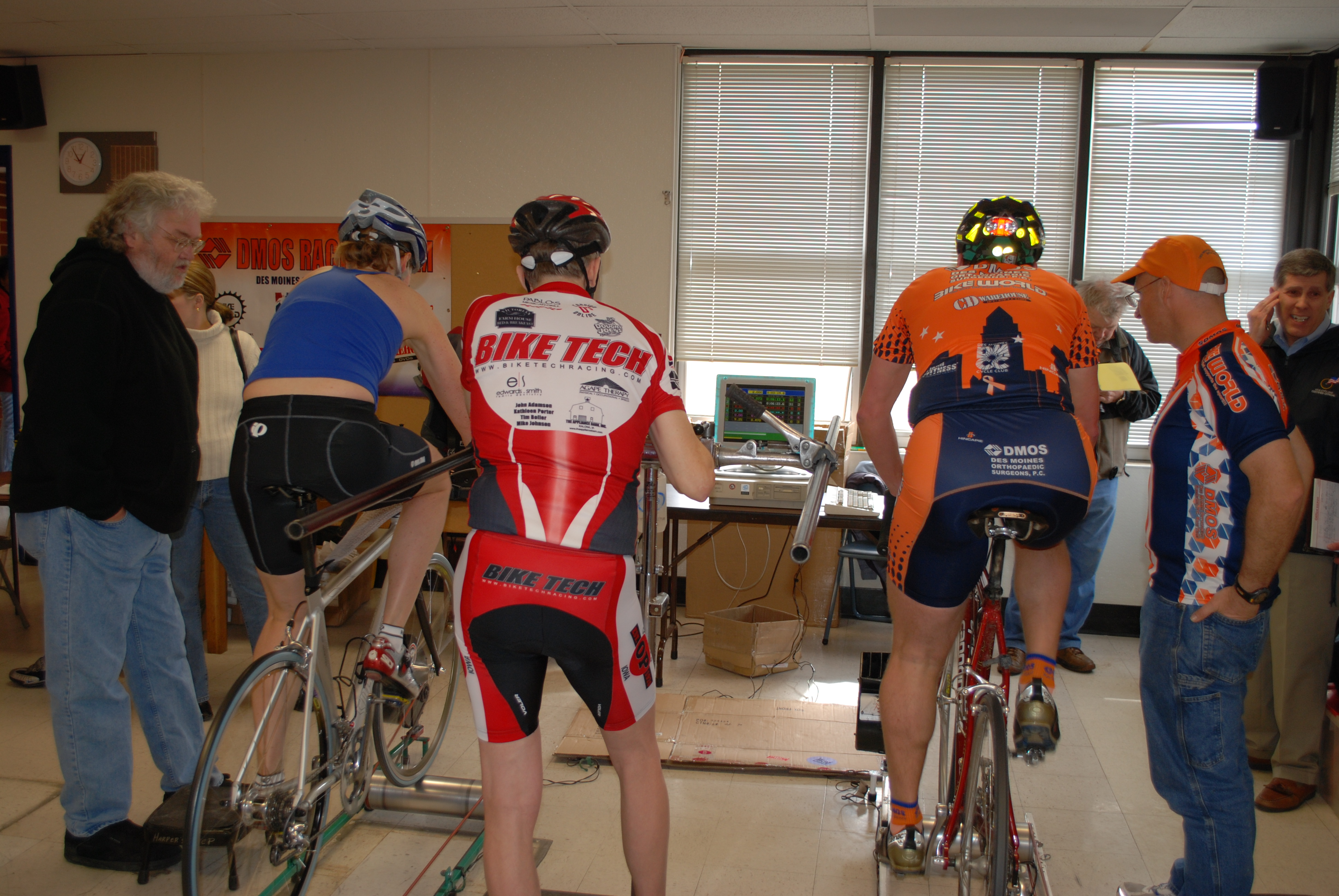
It's currently -2 degrees F here in Iowa. The roads are covered with ice and the wind is blowing. So, for something to do in the winter, we have a Roller Race Series during January and February. Here's how they work. Races are conducted on Kreitler Headwind rollers. These have a fan attached to the front of the roller (with it wide open) and a flywheel attached to the back. This creates a LOT of resistance. The rollers are attached to a computer which tracks the time, distance and pace of the racers. Races are for 2 miles. There are two rollers and people go off in pairs although they are really racing against the clock, just as in time trialing. There are categories just like road races, including juniors, women, seniors and masters. Prizes are awarded to the top three in each category. There are 8 races this season. At the end of the series, medals are awarded to the top racers based on the average of their best three races.
While 2 miles doesn't sound like much, believe me, this is the toughest form of cycling there is. It is 2 miles of all-out effort. Really strong riders can complete the 2 miles in 6 minutes or less (a whopping 20 mph pace). Think of it as a 2 mile hill climb. Shortly after the first minute, riders are anaerobic and have to hold that for the remaining time. Seconds and hundredths of a mile slowly creep by.
I raced yesterday and wasn't very happy with the time. But I'm determined to improve my time the next time I race. It gives me motivation to keep training. Everyone strives to improve (or at least match) their best time compared to last year. I don't know if anyone else does roller racing, but if you do, let me know.
Click here to read more about this Roller Race craziness.
Now's the time to make set some goals for 2010
I like the Air Force advertisement, "Aim High". If you aim high, you have a chance of achieving great things. Even if you don't accomplish all that you set out to, you will likely accomplish a heck of a lot more than if you didn't aim high in the first place. Without goals, it is almost certain you will not achieve great things. It's essential to develop some key goals for your cycling year, and then develop a plan to execute on your goals. The plan I'm referring to here is a training plan. When I put cyclists on structured training plans, they improve. A structured plan does a couple of important things. First, it creates some expectations for the cyclist which creates some training discipline. The cyclist is much more likely to train and train well if there is a plan. Second, a good plan incorporates several quality workouts each week. Left to their own devices, cyclists tend to do too many mediocre rides and not enough really hard as well as really easy rides. Plans should include workouts which improve all the various aspects of cycling fitness: endurance, aerobic threshold, anaerobic/VO2 max, strength, sprinting, spinning, and of course, recovery.
Dwight Eisenhower once said "In preparing for battle I have always found that plans are useless, but planning is indispensable." What he was saying is we rarely follow a plan the way it is created, but going through the process of having a plan makes one able to adapt the plan as circumstances change. I rarely follow my plan the way it's written every day of the week, but I know how to modify it and achieve the goals I set out for the week even though it didn't work out quite as originally planned. So the fact that you have a plan is a good start to being able to accomplish your weekly goals, even though you may not do every workout that's listed.
So if you don't have your own coach and don't currently use a training plan, and would like to take your training to the next level, do yourself a favor and start using a training plan this year. I know it will help you train better and harder, and allow you to aim and reach higher.
How do you Base Train in this??
I have a pet peeve. Everytime I read a book or article about base training, they tell me that I should be doing the most miles of the year during this period which happens to land right in the middle of winter! Base training is the first stage of a periodized training plan which adds intensity as the season goes along so you can be in peak fitness for your primary events during the summer. A typical periodized plan might look like this:
Transition: take 4-6 weeks easy at the end of the season for full rest and recovery (Oct-mid Nov)
Base: Build endurance and aerobic fitness, also work on strength, leg speed (Dec-Mar)
Build: Start increasing intensity and begin doing more faster training and back off a little on mileage.(April-Sept)
Peak: Build for important events including a taper period (2-3 times throughout summer)
All of these plans are pretty much the same: Do lots of miles during the base period to build up your endurance and aerobic system for the harder training to come in the spring and summer. Well excuse me, but I don't live in San Diego or Austin. I live in Iowa. And even though I managed to get out and ride in the snow yesterday, today roads were ice-covered and there was just no way to ride and get any endurance workout in. So what do those of us do who live further north where the weather isn't so nice (and moving isn't an option)?
Well, here's how I approach the base period living in a northern climate. I try to get in at least one longer ride each week, meaning two hours or more. Getting in two is even better. If the weather is above 35 this is possible if dressed properly. Mountain biking can be done even colder as the woods usually don't have wind to contend with. But what about days when it's very cold (e.g. 5 degrees F) or there is an ice or snow storm? A couple of more options: You can get on your trainer or rollers and force yourself to do a marathon indoor session. This is possible but has a pretty high cost mentally. You have to be very motivated to train indoors for hours at a time. I know some people who do it and they are motivated, maybe even obsessive?. Another option is to do some sort of cross training that allows you to exercise for a couple of hours. Skiing (especially cross country), snowshoeing, ice skating are all winter options.. If all else fails go for a rapid hike. The point is to do some activity which elevates your heart rate into your endurance (zone 2) range and keeps it sustained there. Take advantage of warmer days and get out and do some endurance rides whenever you sneak them in this time of year.
You have to make do with what you have during the base period. Really try to get one two hour workout in each week at a minimum, more if possible. And don't get too frustrated reading about the pros who are riding 400 miles per week this time of year. They are pros, and they live in nice places to train in the winter.
Should you train when you are sick?
There will come a time when you catch a cold or come down with some other illness and you wonder whether you should maintain your regular training regime or take it easy and let yourself recover. There are a couple of 'it depends' to this answer. First, it depends on how sick you are and where you are feeling the effects. Second, it depends on the time of year and whether you are building for a major event. .
There is a common rule of thumb used to decide when to train and when to rest and here it is: If your illness is confined from the neck up, then train; if below the neck, rest. In other words, if you have a head cold, sore throat or headache you can still train. However, there are still a couple of watchouts. If you have a head cold and you feel tired or too uncomfortable to train, you'd be better off skipping your training, or at least back off on the intensity. Also, if you are afraid this might make your illness worse, you may also choose to lay off your training. Have you ever come down with a cold or flu the day after a hard workout or race? Hard training weakens your immune system and can make you more susceptible to illness. So if in doubt, consider taking it easy.
On the other hand, if you are feeling aches and pains in your muscles or you have a chest cold, don't train. The stress of exertion and hard breathing will likely aggrevate a chest cold and may make it worse. You don't want it turning into pneumonia. Symptoms below the neck often suggest a more severe illness such as the flu, so be safe and rest and recover.
If it is the middle of the training season and you are preparing for a major race or ride, you will want to be more aggressive with training or your preparation will suffer. If you come down with a cold you might have to push through it. This may not be real comfortable or enjoyable but if you want to keep up with your routine, you should consider sticking with your plan. But again, stick with the above/below the neck rule. Even if you are in the middle of training for an upcoming event, rest and recover if it's below the neck. If you get sick in the off-season or early season training, you don't have to push yourself as hard. You can choose to rest if you wish.
Best advice I can give is to stay well! But if that fails, hopefully this advice will help.
Read all of my cycling training articles
Don't forget to drink when it's cold out
I was out for a ride yesterday, enjoying our unseasonably warm temperatures. After about 20 miles in to the ride, I looked down and realized I had not yet taken a drink from my water bottle. When it's cold out I don't tend to drink as much and I assume that's the case with you as well. First, with the colder air, you don't get as thirsty and second, you are not as hot and don't need to water to cool you down. But this doesn't mean you shouldn't drink. You are still sweating even when it's cold. Just feel the moisture in your under layers of clothing when you get done with a ride in the cold. They probably will be soaked. But you also exhale just as much moisture through your breathing when it's cold as when it's hot, and you lose a lot of moisture through this water vapor. I am not a big fan of forcing myself to drink when I'm not thirsty. I believe that the thirst mechanism works fairly well, especially when it's warm out. But when it's cold, we need to be more conscious of our drinking to make sure we are doing it when it's cold out. Once I started consciously drinking yesterday, I ended up draining the bottle before I got home, so I was more thirsty than I realized. So bottoms up!
Read all of my cycling training articles
Why you need endurance to go fast
It may sound counter-intuitive, but doing long, steady endurance miles will increase your ability to go fast. How can this be? It seems like riding at a fairly moderate pace will increase endurance but how can riding slowly make you ride faster? Even I tell people that if they want to become a faster cyclist, they need to train faster. But, training slower can also help and here's how.
Endurance pace riding, also called LSD for Long Slow Distance, or Long Steady Distance, is when you are riding at 60-75% of your max heart rate. This is a fairly easy pace. When you train at your endurance pace, you utilize quite a bit of fat for fuel along with carbohydrate. This trains your metabolic system to become more efficient burning fat. This is important because the more efficient your fat burning machinery is, the more fat and less carbs you will burn when you pick up the pace, such as in races. The more fat you can burn, the longer your limited carb reserves will last, allowing you to keep some of this fast burning fuel in your tank towards the end of the event, when you need it the most.
Another thing that occurs when you ride at endurance pace is you build your metabolic machinery to be more efficient at aerobic levels of exertion. This includes improving things such as capillary density in muscle, the efficiency of your heart and circulatory and respiratory systems. You improve the levels of aerobic enzymes and pathways. So how does all of this aerobic fitness improve your ability to go faster, especially during anaerobic efforts?
The answer is that the larger and more efficient your aerobic engine, the longer you can rely on that before you have to enter into your anaerobic level, where acid builds and eventually limits your efforts.
If through your aerobic training you can improve your aerobic efficiency, this will help increase your anaerobic threshold, that level at which your lactic acid begins to increase, signally an anaerobic dominate level of exertion. The longer you can stay aerobic and avoid going anaerobic, the longer you will last. If you competitors go anaerobic before you do, you will have a good chance to outlast or outsprint them.
So, do your endurance riding year round. This not only will maintain and build your endurance but will increase your aerobic capacity and allow you to go faster and harder late in events.
Read all of my cycling training articles
5 Principles of a Sound Training Plan
Here are five principles of a sound, high quality cycling training program. If you want to be a faster cyclist, you should do these five things.
1. Ride a lot. Makes sense and probably goes without saying, but if you want to be the best that you can be, you will need to be on your bike, a lot. By a lot, I mean at least 10 hours per week. It's true you can be pretty good training less than this but you won't reach your potential. If you can't ride this much, make sure you do the following four items well. They can take you a long ways toward improvement.
2. Ride hard. The only way to really improve is to continue to push yourself harder. If you want to ride faster, train faster. Intervals allow you to ride faster than your normal cruising speed because you only do them a few minutes at a time and then can rest. When doing intervals, you should be going at a pace faster than what you can maintain for 15 minutes or more. You should do intervals two times per week, most of the year.
3. Ride consistently. The only way to get better is to be consistent with your training. The best way to lose fitness is to train inconsistently. It's amazing how much progress you can make if you just keep training regularly. You don't have to kill yourself each time you ride, just push a little harder or go a little farther or lift a little more weight each time.
4. Mix it up. Add variety to your training. You need to work your endurance, strength, leg speed, climbing ability, aerobic and anaerobic capacity, power and sprinting. You should work on each of these. No need to do the same pace or distance every day.
5. Pay as much attention to your recovery as you do to your riding. Keep in mind that riding provides the stimulus to improve, recovery actually is when the improvement occurs. Or, said another way, riding tears your body down, its the recovery that allows you to heal and come back stronger. Recovery includes lots of rest and good nutrition. Recovery is as important as riding.
There you have it, the five keys to a successful training program. Do these and you will improve.
Why Aren't Cyclists Real Muscular?
In the October 2009 issue of Muscle & Fitness, a magazine aimed at body builders so you probably haven't read it, there is an article titled "3 Reasons You Are Not Ripped". In other words, why you don't have large, defined muscles, which is important to body builders. One of the three reasons caught my attention. It said you do too much cardo. It said that doing too much cardio can burn muscle and consume energy that is needed to build muscle. They said if you wanted to see what a lot of cardio will do, go visit your local marathon or triathlon club. Might as well add bike club to the list. So that got me thinking. First, cyclists don't really care if they are ripped. We are more concerned with being fast. A lot of cyclists do have fairly decent sized leg muscles and many are very defined. But most good cyclists do not have huge legs. Why is that?
Firstly, endurance athletes only have as much muscle as they need to propel themselves forward for long periods of time, no more. Any excess muscle is added weight which slows us down. Secondly, doing hours of cardio will burn some muscle tissue for energy. That's why protein consumption is recommended during long rides, as well as after rides. But if you put long hours in the saddle, don't expect to be able to put on muscle. Thirdly, to gain muscle, you need to be consuming excess calories. Gaining muscle is similar in this regard to gaining fat, you have to be eating more than you are burning. Most cyclists do not eat more than they burn. So if you want to add some muscle this winter, which wouldn't hurt a lot of cyclists by the way, cut back on the long rides and make sure you are eating enough carbs and protein after your strength workouts.
Another question - are cyclists' thinner muscles and frames due to all their riding, or is it the other way around? Are people who are drawn to cycling, who enjoy it, and do well in it, those people with thinner builds? I have a theory that to a great degree the sport chooses the athlete. Yes, you will see heavy and bulky people running 10K's, doing triathlons and riding centuries, but most are leaner and less muscular. Cycling is great because it is more welcoming to different body types, but still you don't see too many large cyclists. But if you are larger, either due to fat or muscle, spend enough time in the saddle and watch what you eat and over time you will shrink.
Junk Miles: What are they and are they bad for you?
You've probably heard people use the term 'Junk Miles'. It's a term I've used and I've heard the term used in different ways and wanted to try to add some clarification to the definition and discuss whether or not they are bad for you and should be avoided.
Some people have used the term Junk Miles to describe any riding that is done at slow speeds. I don't like this description because there are many reasons why this kind of riding is not 'junky'. More than once I've been criticized for using the term and have had people tell me that all miles are good and there is no such thing as junk miles. If your intent is to ride at your chosen pace and enjoy yourself, I can't disagree. So, here's my definition: "Junk Miles are those miles ridden at a pace fast enough to cause fatigue but not fast enough to cause a training effect" Obviously, from this definition, I am referring to training. If you are not riding your bike to train and to get faster, then the term 'junk miles' does not apply to you. If you are a recreational cyclist and just enjoy riding for the joy of it, then all miles are good.
When I use the term Junk Miles, I am referring to riding that is done which does not help you improve
but makes you more fatigued and gets in the way of recovery. Another way to say it is: Junk miles are recovery miles that are ridden too hard. Let's take an example: Let's say you are training for a race and you have done one day of anaerobic intervals and the next day you did some hill repeats. On the third day you are due for a recovery day. Active recovery is where you get out and spin on your bike so move your legs but do not ride hard enough to do more harm to your already tired legs. You should feel very little resistance on your pedals and spin at a high cadence. This is what coaches refer to as Zone 1. Now here's where junk miles come in. You start out with good intentions of spinning easily in a low gear. Up ahead you see another rider and your competitive juices kick in. You start increasing your speed to see if you can catch that person. Pretty soon you are riding at your endurance (Zone 2) or tempo (Zone 3) pace. You may even stand and charge up a hill. Perhaps you even catch that rider. Now what? You have to save face and not slow down, even though you know you should, so you keep riding hard and put distance between the two of you. Your active recovery ride has just become another training ride. Three things have just happened: 1) You blew your recovery ride and went way beyond a recovery effect 2) You tired your legs out even more instead of letting them recover and 3) You pushed hard, but not hard enough to improve either your leg strength or cardiovascular fitness. The Tempo pace is usually what gets people in trouble. This pace is faster than what you usually ride on longer endurance rides, but slower than what you would do during intervals. It's that in-between zone often called 'No Man's Land'. Riding at tempo pace does have it's place but should not be substituted for recovery rides.
Typically following a recovery day is another hard training day, so if you stick to your plan, the next day you are out there trying to train hard but you probably won't have a very good ride. That's because you didn't recover on your recovery day and still have residual fatigue. So now you've compromised your intense day of training. This is where I apply the term junk miles - when you push hard enough to prevent recovery but not hard enough to stimulate further improvement. Plus you've compromised the following quality workout.
You would have been much better off all the way around if you kept your recovery day easy. Let that rider go up the road.
Know that doing these slow easy recovery miles is just as important as the fast, hard training miles. Don't worry about what others think about you. Maybe you are all decked out in your racing kit and don't want to be seen going slowly by recreational, or worse yet, by other racers. Stick to your guns and ride slowly. By riding slowly you are recovering so you can ride faster tomorrow.
This definition of junk miles goes along with another one of my favorite sayings: "Every ride should have a purpose." Note this doesn't say every ride should be hard or fast. If your purpose is to do hard anaerobic intervals and you do that, you've accomplished your objective. If it is to ride around the neighborhood looking at the changing leaves and you do that, then you've also accomplished your purpose. But pay particular attention to those days where you intentionally want to go easy and allow your legs to recover. If you ride too hard, you've missed your objective and ridden junk miles. So using my definition of Junk Miles, if you ride hard enough to either add fatigue or prevent recovery but not hard enough to improve, then you've done junk miles. It would have been better to ride more easily. There is a time and place for recovery or slow riding. Don't junk them up by overdoing it.
Very Basic Cycling Training Plan
If you always wished you could follow a more structured cycling training plan but didn't know where to begin, read on. Here is a very basic but effective plan that will help you to become a faster, stronger, more powerful cyclist.
There are two things to consider - the type of rides you do and the spacing of them during the week. Plan on doing four days of quality workouts per week. Each week will include two interval workouts, a hill climbing or leg strength day, and a longer endurance ride. The intervals should include one day of shorter, faster intervals (1-3 minutes each) and another day doing longer intervals (5-20 minutes). These workouts cover the key cycling attributes. It's also important to spread these out so you can recover following the cycling days so you can come back fresh for the next one. So here is a template you can follow:
Monday: Day off or upper body/core strength day
Tuesday: Short, fast intervals
Wednesday: Day off or easy spin
Thursday: Hill climbing or leg weights in gym
Friday: Day off or upper body/core strength day
Saturday:
Longer intervals
Sunday: Endurance ride
There you have it. Do this consistently and you will get faster. This plan can also be followed during the winter. You may have to be creative in getting in an endurance ride, or do some cross training that allows you to move for 2+ hours. But the other days can be done indoors as well as outside. Consistency of training is as important as the type of training you do, so get on a plan and go!
For additional ideas on the types of workouts you should be doing on these, check out my book, 101 Cycling Workouts.
You only get one chance to ride this day
We all have days where we put off getting in our ride or workout. We assume we will fit it in later, and of course for one reason or another that doesn't happen. We tell ourselves that we will make up for it tomorrow. However, if you miss getting in your ride today, you will never get today back and it is a missed opportunity. If you are serious about your riding and training, it is difficult to make up for a lost day. You may have a planned rest day tomorrow and you can switch that with today but that may mess up your plan for the rest of the week. If not, go ahead and do today's planned ride tomorrow. What you want to avoid is to push back your intense workouts so they end up back-to-back-to-back. Two days of hard riding in a row is okay but your workout will suffer with three days.
Better yet, be proactive in planning your time to be sure you get your ride in on the scheduled day. As you plan your day, think about your riding first. Figure out when you have time to fit it in, then build your rest of the day's schedule around that. If you wait until you get going on your daily activities, you will find that your day is filled up and you'll have trouble fitting in your ride. So put it in your schedule first - it will increase your odds of getting it done today.
10 Reasons To Train Indoors
While I'll be the first to admit that training indoors is not as much fun as riding my bike outside, there are 10 reasons why you need to consider it. In fact there are times when you can get a better workout indoors than outside. While the purists will say the only riding that counts is riding outside, I'm talking mostly about getting in quality workouts. Sure, you may be accused by your cycling buddies of not being tough if you opt for an indoor workout, but you willl likely get a much better workout indoors where you can concentrate on your training than if you ride outside where you are mainly fighting to survive. Plus, how many times do you need to prove you are tough by riding in the rain or sub-freezing temperatures?
1. Winter: Most people equate indoor training with cold, snow, ice and wind of winter. Riding outside can expose you to wind chill, frostbite and falls. Training indoors is often the only safe alternative. You can often get a higher quality workout indoors than you can trying to survive riding outdoors.
Click HERE to read the rest of this article
Spinning Your Way to More Power
If you are like me, you equate power with strength. The stronger you are, the more powerful you'll be, right? Well, that's half the equation. Strength is the amount of force you can place on the pedals. Power is the amount of force you can apply to the pedals AND the speed with which it is applied. So to develop greater power, you should be working on your leg strength and your leg speed. There are lots of workouts for leg strength. I want to share with you a workout for leg speed. Now I'm not talking here about leg speed drills, where you spin as quickly as possible with low resistance which is done to increase the fluidity of your pedal stroke. I'm talking about spinning fast under high resistance, to train your leg muscle fibers to fire quickly while working hard. You see, the idea is to train your muscles to fire rapidly while putting out a large amount of work.
Try this workout to increase your cadence under high power:
High Cadence, High Power Intervals: Find a level road or hill with steady grade. Select a gear which allows you to pedal 10-20 RPM faster than your normal cadence but also allows you to ride faster than your threshold pace. Using speed, this would be 1-2 MPH faster than your time trial pace. If you have a power meter, this would be about 20 watts above your functional power level. This is a high power level to force your muscles to fire a lot of fibers, yet the high cadence also forces them to fire quickly. Do intervals as long as you can until your cadence drops to under 100 RPM. Recover and repeat several times.
These are very hard intervals. Your heart rate and breathing rate will be very high, because you are putting out a lot of power and you are not able to rely on leg strength as much as leg speed. This requires a lot of aerobic and anaerobic energy. You may not be able to do these intervals very long at first. Work on increasing the duration and number of these and you will be on your way to increasing your power through faster leg speed. I'm not talking about making you into a spinner if you are a masher, but if you can increase your cadence just 5 RPM while maintaining your leg strength, you power will increase about 5%. That's a huge increase. Give it a try and see what you think.
Cross Train Your Brain
I picked up a copy of Running Times at my fitness center yesterday and flipped through it. I ended up reading several articles and was intrigued to see how many of these were similar to what we talk about in cycling training. Just change the words 'runs' with 'rides' and change '10K pace' with 'time trial pace', and they could be very interchangeable. These articles talked about endurance, speed, strength and core workouts, just as we do.
There were also some new concepts
or the same concepts from different perspectives. Much of running is aerobic so they tend to emphasize that more, but they do include a day or two of speedwork each week as well. It was also interesting to read the writings of running coaches to get a slightly different twist on aerobic and anaerobic training compared to cycling coaches. Same concepts but different approaches and terminology.
So the next time you are at a magazine rack, don't be afraid to pick up a running, triathlete, or mountain biking magazine. Read what they have to say about training and you may find it applies very nicely to cycling training.
Is Coke® a Good Sports Drink?
I went to the final stage of the Tour of Missoui on September 13. I watched at the feed zone for a few laps. I noticed that some of the teams were pouring Coke into the riders' bottles. In this day and age of high tech, scientifically formulated sports drinks, some riders still prefer Coke. Is this a good idea and what constitutes a good sports drink?
First, a sports drink needs to taste good, which is why I imagine riders still continue to prefer Coke. If you like the taste of your drink, you will drink it more often and more of it. What's the sense of having the most perfectly balanced drink if it tastes like limey salt water? After the last lap of the race, one of the teams handed out unused bottles of their sports drink and I took a taste and it didn't taste very pleasant to me. I wouldn't be inclined to drink much of that especially as it gets warmer.
Second, a sports drink needs primarily three ingredients. Water of course, some form of carbohydrate and some electrolytes to replace those lost in persperation. A preferred form of carbohydrate is maltodextrin. Maltodextrin is a chain of pure glucose which is quite rapidly available to the body, which is what you want from a sports drink during a ride. Many drinks contain sucrose. Sucrose is a 50:50 blend of glucose and fructose. Fructose must be converted to glycogen in the liver before it is useful to the body, which takes some time. So sugar is not as fast acting as maltodextrin. Coke contains high fructose corn syrup, which is almost identical to sucrose - about a 50:50 blend of glucose to fructose. So Coke isn't the best source of quick energy, but very similar to what many sports drink makers use, including Gatorade. Electrolytes are minerals such as sodium, potassium and calcium. Most sports drinks contain these to help replenish those lost in sweat and to keep muscles firing properly to avoid cramping. Coke doesn't contain any of these.
The big downside of drinking any colas is their phosphoric acid content. Phosphoric acid has been linked to decreased bone density, something cyclists can't afford as cycling itself has been linked to lower bone density.
So how does Coke stack up as a sports drink? If riders like it, and they drink it, that's a big plus.. It does contain sugar for energy. It doesn't contain any electrolytes but it does contain caffeine which may provide a little lift during a long ride. Caffeine has also been shown to help increase fat burning during endurance exercise, thus providing a sugar sparing effect. So I'll stick to my Heed, but Coke provides more of the benefits of sports drink then you may realize at first glance. If you do decide to use a cola, pour it in your bottle and let it sit with the top open for a while before your ride to get rid of the carbonation.
POWER = STRENGTH X SPEED
I had the opportunity to meet with Scott Damman this week. Scott works with the Myotest strength testing system (www.Myotest.com), which measures the body's ability to produce force and power. We got into a good discussion about the importance of power and strength to cycling. He gave me some interesting new perspectives to think about. I know power is important to cycling, in fact, it's the most essential output of a cyclist. This is why power meters are so useful to cycling. I had always thought of power in terms of Work over Time (how far the bike travels in a given amount of time).
Work = Force x Distance
Power = Work / Time, therefore
Power = (Force * Distance) / Time
However, Scott gave me another way to think about this. Power can also be thought of as strength (or force) times speed.
Power = Force x Speed, or
Power =
Strength x Speed.
Because Speed = Distance divided time, this equation becomes:
Power = Force * (Distance/Time)
Note this is basically the same equation as above but the parentheses are moved. However, it's not the equation that's important as much as the way it causes us to think about power. Force x Speed can be thought of as the amount of strength needed to move an object, such as a pedal, multiplied by the speed at which the pedal is moved (cadence). This makes an awful lot of sense to cyclists. We know that the speed with which the bike is moving is the product of the gear we are pushing (strength) and the speed with which we are spinning (cadence). One can go the same speed pushing a big gear slowly or spinning a small gear quickly.
The other interesting thing Scott mentioned was that athletes often work on strength in the gym, lifting lots of weights, but don't work on the speed of muscle contraction as much. For cyclists, this could lead to strong legs but without the necessary snap to spin a big gear quickly. I will be thinking about this and how I might approach gym training for cycling this winter. I may get a chance to play around with the Myotest system this winter. If I do, I'll be sure to report my findings.
JDRF Ride To Cure Diabetes
This past weekend I particpated in the Juvenile Diabetes Research Foundation (JDRF) Ride To Cure Diabetes, held in Kansas City. This is a fund-raising cyclign event for the JDRF. People commit to raising a specific amount of money for the priviledge of getting to go to this Ride and they have the option of riding up to 100 miles in one day. One of the benefits of taking part in this Ride is that they receive help training for their ride. I am the coach of the Greater Iowa JDRF Chapter and have been for six years now. I help people prepare and train for this event and hold training rides almost every weekend leading up to the ride. At the Ride itself, I asist people in accomplishing their goal, whatever distance they set for themselves.
While I also coach cyclists who are great athletes, most of the JDRF riders are not necessarily cyclists when they start. Some even have to go buy a bike and begin training. But I have to say, these are some of the most inspirational cyclists I meet during the year. It's very encouraging and gratifying to see people complete their first century, 50 miler or whatever their personal best was. And on top of this, they are all heroes in my book because they are raising funds to go towards finding a cure for Type 1 diabetes. You probably know someone with this disease and what a burden it is.
If you want to learn more, or perhaps are interested in participating in this event, please check out the JDRF website HERE. You may discover it's the most rewarding thing you've ever done on a bicycle.
Drafting: The Great Equalizer
People who don’t follow cycling closely are surprised that the Tour de France winner is often determined by minutes or perhaps even seconds after racing three weeks, covering more than 2000 miles and more than 80 hours. Is it really that these riders are that closely matched? Not exactly. While they are all very elite athletes and very fit, there are more differences in ability than is shown in their overall time. Much of the difference in ability is masked by drafting that takes place in cycling. In cycling, air resistance causes the most resistance a cyclist must overcome, except when riding up hills, where gravity takes over. As cyclists are traveling along at 23 mph, they are generating a 23 mph headwind. When a cyclist rides directly behind another, the wind resistance is about 30% less than that faced by the rider in front. This is why you almost always see cyclists riding together in packs and rarely see them riding alone. It is very difficult to ride alone in a bike race and hold off a pack of riders, who can share the work shielding the wind for each other. A solo rider must be very strong to finish alone out front. This explains why races often finish in pack finishes. It also explains why races, including the Tour de France, finish with the top places separated only by a few seconds. Read the rest of this article
Exercise: The Real Fountain of Youth
For centuries people have looked for the Fountain of Youth, and people today are still looking for potions and pills to help keep them looking and feeling younger. Forget all that, the simple answer to feeling and looking younger lies with regular exercise, something you can start working on right now.
Aerobic exercise helps keep your heart strong and lungs and vascular system working well. It increases your endurance so you don't tire as easily. It allows you to handle strenuous work, playing with kids or grandkids and helps you feel more energetic. Exercise helps you feel better during the day and sleep better at night.
Strength exercises help maintain muscle mass so you are better able to perform daily tasks such as yardwork and climbing stairs. Strengthening muscles also strengthens bones and keeps your metabolism revved up so you burn more calories to help fight weight gain that often comes with age.
Through regular exercise it is possible for your body age to be less than your calendar age. Your body was meant to move. By keeping your body parts moving and working, they continue to function well into old age. Frailty is really nothing more than the deterioration of your body through lack of use. Many of the ailments of aging can be delayed or may even be prevented by staying fit, including heart disease, stroke, cancer, type 2 diabetes, sore backs, imbalance and osteoporosis to name a few. There's even evidence that exercise may even help keep your brain function intact into old age. You have probably been surprised to learn how old some fit people actually are. People are doing triathlons and running marathons into their seventies. They look and act years younger because they have maintained their bodies well and therefore are able to enjoy life and live it with vigor.
If this isn't enough reason to get you off your coach and on your feet, I don't know what is. So get moving and start shedding years!
(Health and Fitness Article written for the August 2009 Beaverdale Sidewalk newsletter)
Crashing - Practice Makes Perfect
June 14, 2009 - I crashed on my ride today. I haven't crashed on my road bike in a long time. Here's what happened. It was near the end of the ride. I was standing up with my hands on the brake hoods stretching and hit a sharp bump in the road and heard a 'crack'. I didn't know what that was but a few seconds later it was apparent. All of a sudden my handlebars were loose and turned sideways. Turns out the bolt in my steerer tube snapped. I was heading for the ditch. I hit the rear brake to scrub some speed and even had time to think this was how George Hincapie must have felt during his famous crash in Paris-Roubaix. I also had time to tell myself to tuck and roll. I rolled my shoulders and tucked my head for the inevitable crash. I was heading for a grassy ditch so it looked like a soft landing and I reminded myself to relax. When I landed with a thud it wasn't too bad. Other than a bump on my knee, no real damage done.
There's a lesson in this. Like everything else, the more you practice, the better you get. I don't crash much on my road bike and I don't go out of my way to practice, but I have to admit this was my best crash ever. I had the instinct to remember to tuck, roll and relax. I do quite a bit of mountain biking and I find myself crashing quite a bit as I try to push the limits on single track. Mountain biking has done wonders for my bike handling abilities. You get familiar with losing the rear wheel traction while cornering, hitting my handlebars on trees, and falling. I'd highly recommend riding a mountain bike not only because it's a blast but because it really will help with your bike handling on your road bike.
Crashes are inevitable if you ride enough. Sometimes crashes happen so quickly you don't have time to think, but if you do, try to relax and roll when it happens to you. The more you do crash, the more instinctively it becomes to do it right, even when you don't have time to think..